Summary & Key Points
"The SPIA project is a consortium comprising Côte d'Ivoire, Ethiopia, and Morocco. The goal is to share tools and approaches, and conduct comparative analyses between Côte d'Ivoire, Morocco, and Ethiopia regarding agricultural innovations."
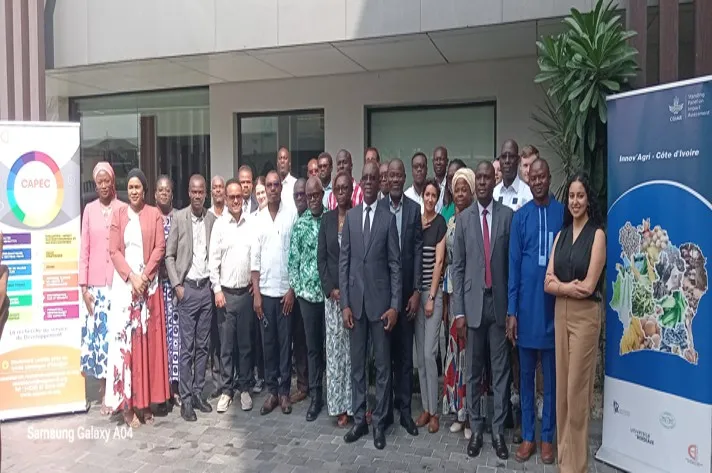
This Thursday, May 15, 2025, the Launch Workshop for the SPIA CI project (Agricultural Production and Innovation Structure) was held at the Silver Moon Hotel in Abidjan. The project designers presented the objectives, research team, methodology, activities, and expected results of the project.
The SPIA project is a consortium involving 3 countries (Côte d’Ivoire, Ethiopia, and Morocco) with the goal of sharing tools and approaches and conducting comparative analyses between these three countries. Specifically, it aims to document and quantify the impact of the Consultative Group on International Agricultural Research (CGIAR) and to support the development of a culture of impact evaluation within each CGIAR center.
In her opening remarks, Ms. Sylvie KOUADIO, on behalf of the Director General of Agriculture, congratulated the SPIA project team, stating that this study will help to “fill the data gaps regarding agricultural innovation in Côte d’Ivoire.” She concluded by commending the quality of the partnership between CAPEC, IPORA, UFHB, and the University of Bordeaux.
Scheduled to last 2 years, the SPIA Côte d’Ivoire project aims to assess and analyze agricultural innovations in CI. To achieve this objective, the team, co-led by Professors Thierry ZOUE (UFHB) and Tanguy BERNARD (U-Bordeaux), has established a research program focused on three work packages (WP):
WP1: Assessment and history of agricultural innovations in Côte d’Ivoire
WP2: Analysis of the diffusion and adoption of agricultural innovations by producers in Côte d’Ivoire
WP3: Public policies and agricultural innovations in Côte d’Ivoire
Discussions between the project team and participants highlighted the level of engagement of stakeholders, including researchers, public decision-makers, the private sector, and civil society. Furthermore, a sociometric matrix provided to the stakeholders involved in the project will be used to map collaborations among these stakeholders.
Finally, the Director of CAPEC (Economic Policy Analysis Unit of CIRES), in his closing remarks, emphasized the importance of collaboration among stakeholders for the success of the SPIA Côte d’Ivoire project. Indeed, in a context of high expectations for agricultural development, the results of this study will ultimately contribute to improving food security and increasing agricultural production.