Summary & Key Points
"EBO-PEP is a consortium of partners aiming to expand the portfolio of therapeutic tools against MVE by evaluating a PPE strategy for high-risk contacts and maintaining a network for sharing knowledge and collaboration around PPE."
EBO-PEP is a consortium of partners aiming to expand the portfolio of therapeutic tools against MVE by evaluating a PPE strategy for high-risk contacts and maintaining a network for sharing knowledge and collaboration around PPE.
In executing the project, experts will establish a clinical trial in Africa to test the efficacy of treatments used as PPE for high-risk contacts; strengthen the capacities of clinical researchers and increase community knowledge regarding Ebola virus research; and define the best PEP strategy for high-risk contacts and advocate for the implementation of PEP in countries affected by Ebola virus disease.
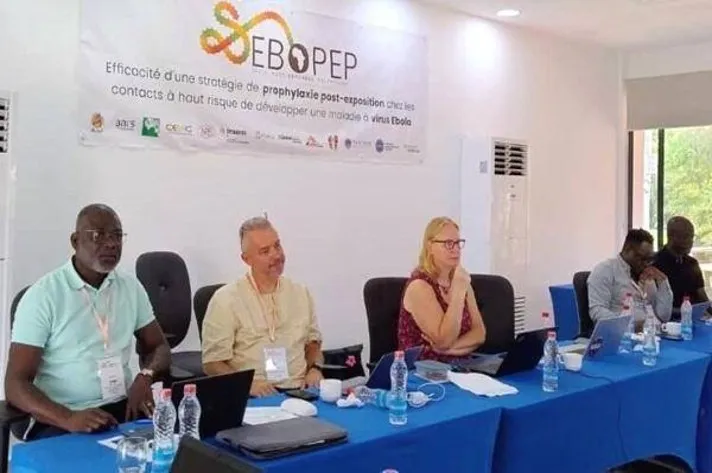
For this collaborative workshop held at the Assoyam Hotel in Grand-Bassam from September 10 to 13, 2024, the various partners from France (INSERM (iPLesp, ANRS-MIE), University of Bordeaux, ALIMA, PANTHER), the DRC (INRB), Spain (ISGLOBAL), Belgium (Médecins sans frontières), Senegal (Cheikh Anta Diop University), Côte d'Ivoire (PAC-CI Program), and Guinea (ANSS, CERFIG) gathered to finalize the protocol and discuss the implementation of the EBO-PEP study.
Several presentations were made, followed by discussions on the clinical trial protocol and the activities of the various working groups. These working groups focus on the overall project coordination, scientific coordination, project preparation program, clinical trial management, health economics, community engagement, and the acceptability of the study by the target populations.
Additionally, participants exchanged views on essential points for the project's success, including the governance of the EBO-PEP consortium, the governance of the EBO-PEP project, and the timeline to facilitate its implementation.
The next meetings are scheduled for September and December 2024 to finalize the protocol, establish the scientific council and the independent monitoring committee, and submit the project.
Participants left very satisfied with the results of the work, the atmosphere of the workshop, and the opportunity for some to discover Grand-Bassam, one of Côte d'Ivoire's tourist treasures.