Summary & Key Points
"AFROSCREEN is a multi-institutional project designed to strengthen genomic sequencing and surveillance capabilities in West and Central Africa and Madagascar..."
AFROSCREEN is a multi-institutional project designed to strengthen genomic sequencing and surveillance capabilities in West and Central Africa and Madagascar. AFROSCREEN in Côte d’Ivoire involves two international networks. These are the National Agency for Research on AIDS and Hepatitis (ANRS) network, which includes the PAC-CI Program, the National Institute of Public Health (INHP), and the Molecular Biology Unit (UBM) at Treichville University Hospital; and the Pasteur Institutes (IP) network, which includes the Pasteur Institute of Côte d’Ivoire (IPCI).
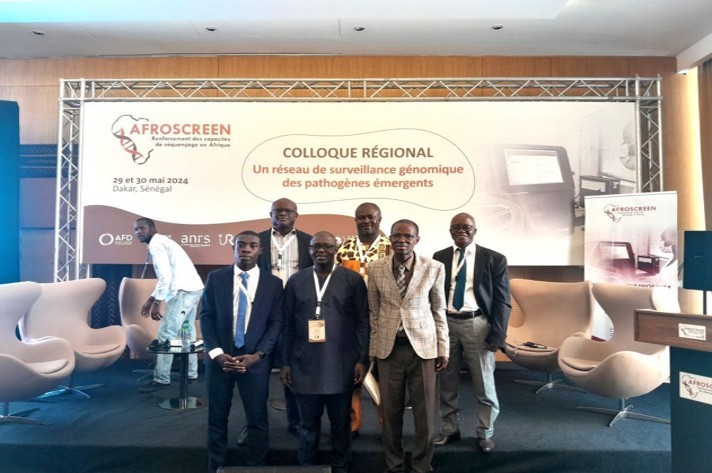
A delegation of seven Ivorian experts from the ANRS network and the IP network, involved in the AFROSCREEN project, visited the Senegalese capital from June 28 to 31, 2024. The visit took place during a regional symposium held in Dakar on the theme: “A Genomic Surveillance Network for Emerging Pathogens.”
Dr. Moh and Dr. Abo, from the PAC-CI Program; Professor Koffi Stéphane and Mr. Kofi Kobina, from the UBM at Treichville University Hospital; Dr. Amani and Professor Tiembré from the INHP, and Dr. Kadio from the IPCI, along with their Senegalese hosts and other experts from eleven countries, gathered at the Azalaï Hotel in Dakar, to discuss the issue of consolidating the network of sequencing laboratories in West and Central Africa and to develop a strategy to ensure the long-term sustainability of the AFROSCREEN Project’s activities.
The discussions focused on the following points: facilitating face-to-face dialogue and the sharing of experiences among partners from West and Central Africa; taking stock of scientific and technical achievements since the programs began; identifying key actions to consolidate the network; prioritizing new challenges and opportunities (both scientific and network-related); discussing synergies with existing networks in the region and identifying concrete future joint or complementary actions for Africa PGI (Pathogen Genomics Initiative) and AFROSCREEN in the field of genomic surveillance.
Experts from the PAC-CI Program, the UBM at Treichville University Hospital, the INHP, and the IPCI participated through a plenary session, roundtables, and a poster session. The topics discussed focused both on general knowledge related to sequencing and genomic surveillance and on the implementation activities of the AFROSCREEN project and the lessons learned since its launch.
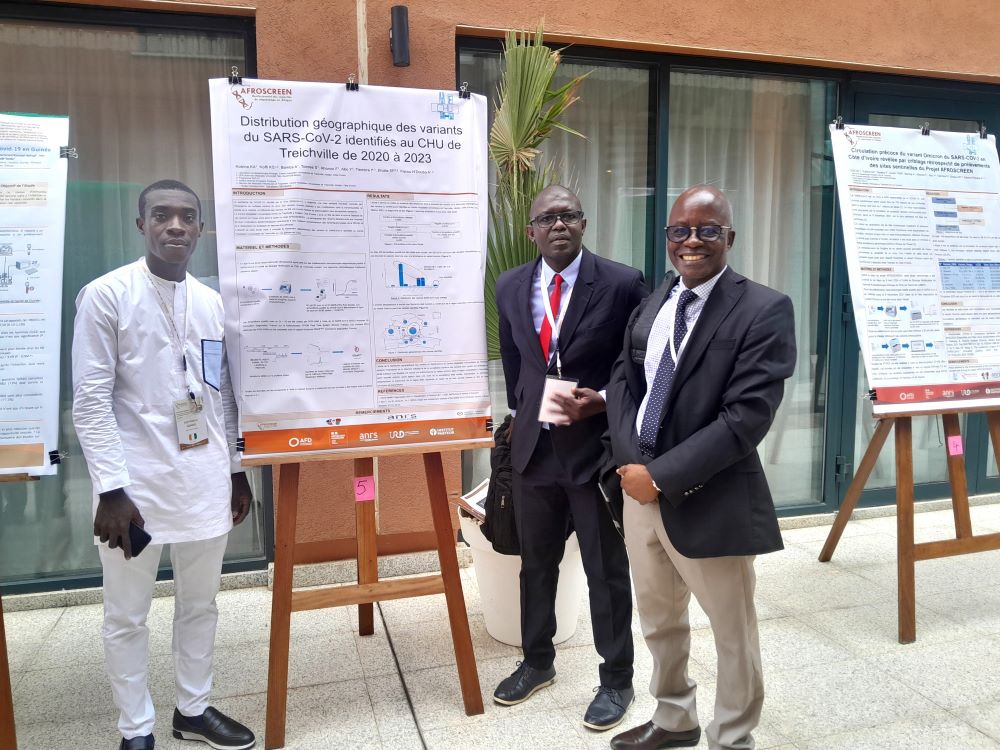
(From left to right) Mr. Kofi Kobina, Dr. Amani, and Dr. Abo Yao, posing next to one of the three posters presented at the symposium.
While the experts at this regional symposium were unanimous in stating that the AFROSCREEN project has had a positive impact on the health systems of the 13 participating countries, they believe that its termination on August 31, 2024, would risk the loss of all the gains made. For this reason, participants raised the need to extend the project with certain adjustments, notably the inclusion of the social sciences in its activities.
Furthermore, to ensure the long-term sustainability of the AFROSCREEN Project’s activities, these experts recommend the following measures: work toward the full integration of the project’s activities into the health systems of the various countries to ensure the sustainability of these activities; involve social science stakeholders to better understand the emergence of pathogens; and leverage the data generated from the project’s implementation over the course of its three-year activities.
Since 2021, when it was launched, the AFROSCREEN project has provided laboratories with equipment and reagents, trained laboratory and epidemiology teams, and contributed to the establishment and strengthening of surveillance systems for SARS-CoV-2 and other priority viruses such as Ebola, Marburg, measles, Mpox, dengue, Rift Valley fever, etc.
PAC-CI
Associate researcher at PAC-CI, contributing to the advancement of scientific research and public health in Côte d'Ivoire.
Contact the author