Summary & Key Points
"Comprising 10 countries (Benin, Burkina Faso, Côte d’Ivoire, Ghana, Guinea, Mali, Nigeria, Senegal, and Togo), IeDEA (International Epidemiology Databases to Evaluate AIDS) is a consortium"
Comprising 10 countries (Benin, Burkina Faso, Côte d’Ivoire, Ghana, Guinea, Mali, Nigeria, Senegal, and Togo) IeDEA (International Epidemiology Databases to Evaluate AIDS) is an international research consortium established in 2006 by the U.S. National Institutes of Health. Its goal is to provide a rich and diverse global resource of HIV data.
IeDEA’s mission is to collect observational data representing more than 2.2 million people living with HIV or at risk of HIV; this data is provided by clinical centers and research groups in 44 countries. These data are organized into seven geographic regions and coordinated by centers for the Asia-Pacific, the Caribbean, Central and South America, Central, East, Southern, and West Africa, as well as North America.
In West Africa, IeDEA aims to identify individual and structural barriers along the continuum of care for people living with HIV (PLHIV), from HIV testing through retention in care to viral suppression; to evaluate the impact of new preventive approaches aimed at reducing AIDS-related morbidity, particularly comorbidities such as tuberculosis and cervical cancer; to determine the burden of noncommunicable diseases and assess their interaction with HIV infection among PLHIV.
In fact, invasive cervical cancer remains one of the most common cancers in West Africa. Unfortunately, women living with HIV are six times more likely to develop cervical cancer than HIV-negative women. Today, thanks to advances in research, several prevention methods are available: HPV vaccination, screening, and treatment of precancerous lesions.
In Côte d’Ivoire, a screening program has been in place since 2010 and targets both HIV-negative and HIV-positive women aged 25 and older. This program uses visual inspection with acetic acid (VIA) for screening and cryotherapy for treatment. To address the drawbacks associated with cryotherapy, Côte d’Ivoire has adopted the WHO recommendation to replace cryotherapy with thermoablation.
Thus, as part of the 2021–2026 cycle, IeDEA is conducting two studies in West Africa: 1) CASCADE, whose primary objective is to assess the impact of implementing HPV testing and thermoablation on the demand for screening and access to treatment for precancerous cervical lesions. 2) IPHOTHER. Conducted in Abidjan and Abobo-Dioulasso (Burkina Faso), this study aims to estimate the incidence and persistence of oncogenic HPV infections and precancerous cervical lesions according to HIV status at 36 months, as well as associated factors following treatment with thermoablation or RAD.
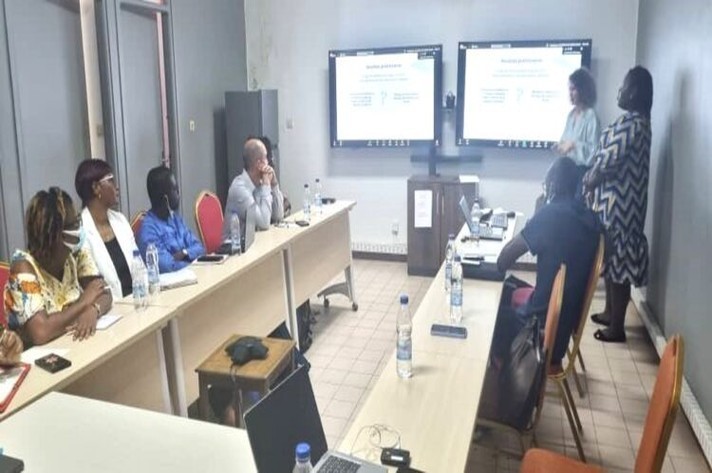
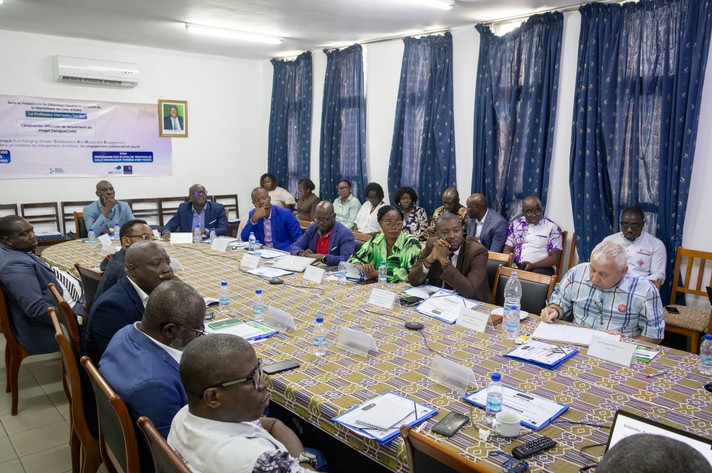
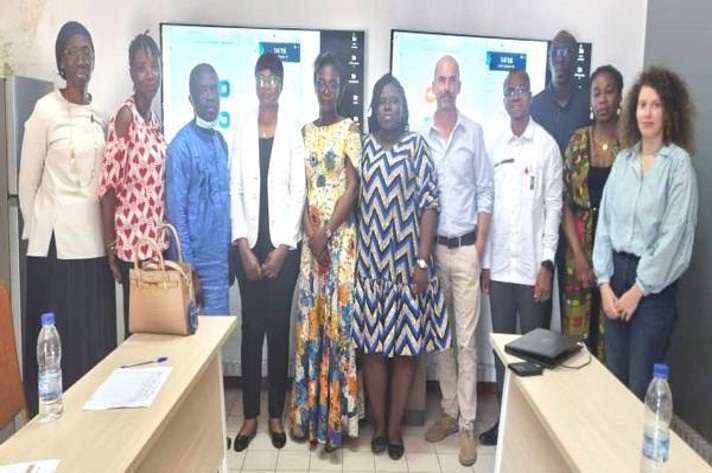
To provide a progress report on the CASCADE and IPHOTHER studies, discuss the plan for disseminating the findings of these projects and the next steps that the Steering Committee for Cancer Studies in West Africa met on October 10, 2024, at the headquarters of the National Cancer Control Program (PNLCa) in Abidjan. The meeting was attended by about a dozen participants, including the principal investigator, Dr. Antoine JAQUET (from the University of Bordeaux), and the IPHOTHER project coordinator in Burkina Faso, who joined via Zoom.
During the meeting, the group dynamics were positive, with active participation from the steering committee members. Various presentations were given, notably by the project manager and the social science researchers (qualitative component) on the progress and implementation of the different projects. Thanks to insightful discussions and contributions, several recommendations were made with a view to improving the quality of the results from the CASCADE and IPHOTHER projects.
These include, among other things, improving the follow-up of women in the HIV-negative women’s cohort (SUCCESS cohort) to limit attrition at 12 months post-enrollment, the prompt analysis of the quantitative data collected from both CASCADE and IPHOTHER (the cohort of women living with HIV or the AIMACC cohort), and the continuation of qualitative data collection for IPHOTHER for one more month before the study’s conclusion.
Ultimately, the results of these studies will provide evidence to guide decision-making aimed at improving the performance of the secondary prevention program as well as enhancing long-term follow-up for women treated with thermal ablation.
PAC-CI
Associate researcher at PAC-CI, contributing to the advancement of scientific research and public health in Côte d'Ivoire.
Contact the author