Summary & Key Points
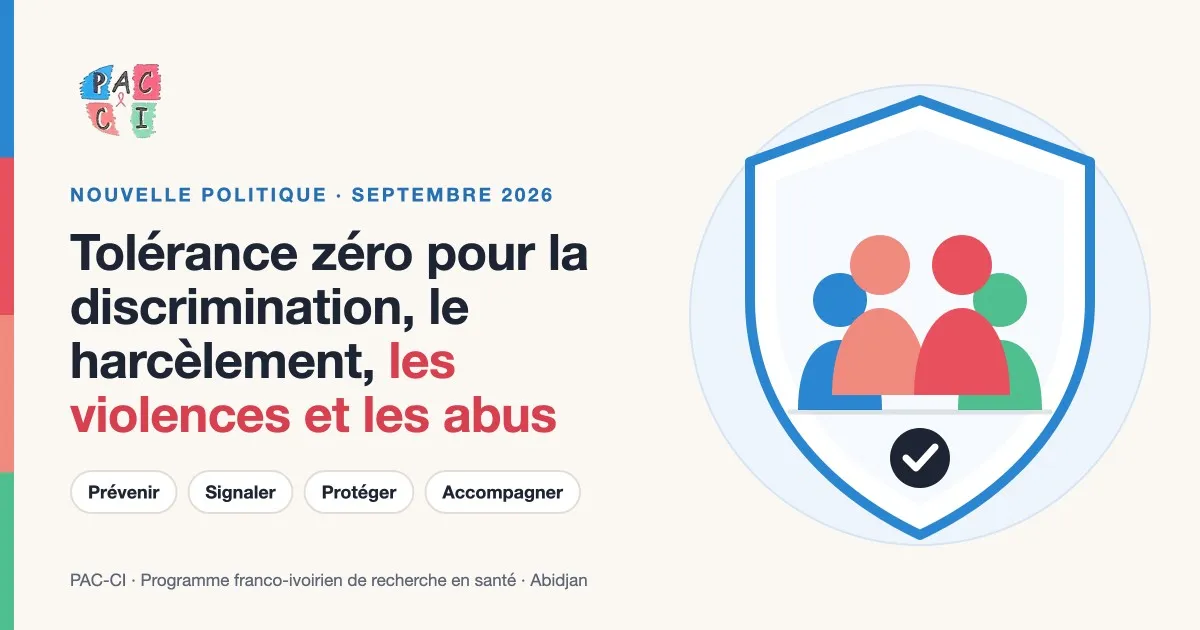
"As of September 1, 2026, PAC-CI has a formal policy for preventing and combating discrimination, harassment, violence, and abuse. This text, adopted by the Executive Board and signed by the Executive Director, Dr. Raoul MOH, reaffirms a simple principle: every person who works with or for PAC-CI must be treated with dignity and respect."
A commitment commensurate with our mission (View the Source File...)
Since its creation in 1996, through an agreement between the Ivorian ministries of Health and Economy and Finance, the French Ministry of Cooperation, and ANRS, PAC-CI has conducted health research for the benefit of populations. Initially focused on HIV/AIDS and infectious diseases, the program has expanded to include non-communicable diseases, sexual and reproductive health, and, today, global health.
This mission relies on teams of diverse origins and nationalities, as well as numerous national and international partners. To ensure that this diversity remains an asset, a serene work environment, free from fear or apprehension, is essential. The new policy sets this framework: it defines prohibited behaviors, organizes prevention, and describes how victims are protected and supported.
Who is the policy for?
The policy applies to all PAC-CI staff, regardless of their contract: leaders, managers, central and regional office staff, and employees at all levels. It also concerns anyone linked to PAC-CI by a contract: interns, consultants, subcontractors, suppliers, and service providers. Research project participants are also subject to its awareness and fair treatment objectives.
Four clear objectives
- Prevent violence, harassment, and abuse in all their forms.
- Raise awareness, train, and inform staff, partners, and research project participants.
- Maintain a friendly environment, free from violence, harassment, abuse, and discrimination.
- Ensure fair treatment of staff, partners, and participants.
A solid legal framework
The policy is based on national and international texts:
- the ILO Declaration of 1998 on fundamental principles and rights at work;
- the Ivorian Labor Code (2021), which prohibits employers from considering sex, age, origin, religion, opinions, union activity, HIV status, or disability in their decisions. It also protects anyone who refuses to submit to harassment or testifies against it from any sanction;
- the Ivorian Penal Code (Articles 418 and 419), which punishes sexual harassment with one to three years' imprisonment and a fine of 360,000 to 1,000,000 CFA francs;
- the Ordinance No. 2013-660 on combating corruption, which penalizes abuse of authority aimed at obtaining favors.
What the policy combats
The text specifically names the behaviors it prohibits:
- Discrimination: treating someone differently because of their gender, pregnancy, sexual orientation, age, religion, opinions, language, origin, social status, or disability.
- Abuse of power: pressure, requests for favors, incitement to give false testimony or bypass rules, obstruction of a colleague's work.
- Psychological and moral harassment, including cyber-harassment: devaluation, contempt, degrading remarks. A single serious act can be enough to characterize it.
- Sexual harassment: persistent remarks, advances, touching, promises, or threats related to a sexual favor.
- Sexual assault: any sexual act committed without free and informed consent.
- Physical violence, including against property.
- Stigmatization: attributing a negative image to a person because of a real or perceived characteristic.
Prevention above all
For PAC-CI, prevention is the cornerstone of the system:
- Information upon arrival: an information sheet is given to each new employee, partner, intern, or student, supplemented by an oral presentation during the onboarding process.
- Posters and video capsules on awareness, reporting procedures, and victim support.
- Mandatory online training, with certification, for each employee. Abuse of power is regularly included in the continuing education program.
- Formal adherence: any concerned person signs the internal regulations, which include the policy. This is a prerequisite for any collaboration.
Reporting an incident: a clear and protective procedure
Because prevention does not reduce the risk to zero, the policy provides a single procedure for reporting and handling incidents:
- Dialogue: if possible, the person who believes they are a victim starts by discussing the issue directly with the person in question. They can be accompanied by a member of the Mediation Committee.
- Written complaint: in case of failure, a written complaint is filed in a sealed envelope with the human resources department. It is recorded with a tracking number and transmitted to the Executive Directorate.
- Mediation Committee: this committee of five members (two members of the Executive Board, a representative of the staff delegates, a member of the social service, and a member of the complainant's service) checks for any conflict of interest and examines the admissibility of the complaint.
- Amicable settlement: mediation is proposed first. If one of the parties refuses, an investigation is opened.
- Impartial and confidential investigation: testimonies, documents, written or electronic exchanges are examined. The absence of a direct witness or material evidence is not sufficient to dismiss an allegation. Each investigation is reviewed by Internal Audit.
- Conclusions: human resources communicate the conclusions to the parties and implement the proposed measures. The report remains confidential.
Anonymous reporting. A secure online form will allow reporting facts without revealing one's identity (except in cases of harassment, which require that persons be identified).
Protection against retaliation. The complainant is protected against any retaliation, even if the complaint does not result in action.
External recourse. In case of doubt, anyone can also contact the National Directorate of Labor Inspection (Plateau, Tower A, 11th floor, Abidjan; tel. +225 27 20 21 08 87 / 27 20 22 25 96 / 27 20 21 12 47).
A shared responsibility
The policy clearly defines roles. The Executive Board approves it and ensures its follow-up. The Executive Directorate disseminates it, implements it, and is responsible for handling allegations. The human resources department regularly assesses risks and the effectiveness of measures, consulting with staff representatives. The Mediation Committee presents an annual report on its activities at least once a year.
Everyone also has a role to play: employees and partners are invited never to let a situation of discrimination, harassment, or abuse flourish and to report it when they witness it.
In brief
With this policy, PAC-CI reaffirms that the quality of health research also depends on the quality of human relations. No form of violence, discrimination, harassment, or abuse is accepted or tolerated. The text came into force upon its adoption by the Executive Board and may be revised as necessary, upon a proposal submitted to the human resources department.
For any questions or to report a situation, contact the PAC-CI human resources department.
Christian Kouadio
Clinical Research Associate and Communications Manager at PAC-CI
Contact the author